





Introduction
Attention deficit hyperactivity disorder (ADHD) symptoms, internalizing problems, and conduct problems are among the most common as well as commonly co-occurring neurodevelopmental and mental health issues in childhood (e.g., Angold et al., Reference Angold, Costello and Erkanli1999; Murray et al., Reference Murray, Eisner, Nagin and Ribeaud2020). Identifying early-emerging transdiagnostic risk factors for these issues can inform the design of efficient early interventions. Further, while the precursors of ADHD symptoms, conduct problems, and internalizing problems may be present from early in life, they are often not diagnosed until school age and beyond (Association, Reference Association2013; Kessler et al., Reference Kessler, Berglund, Demler, Jin, Merikangas and Walters2005; Rocco et al., Reference Rocco, Corso, Bonati and Minicuci2021). As such, identifying early markers of these issues can be important for facilitating timely referral, diagnosis, and targeting of preventive interventions. The goal of the current study was to examine emotion dysregulation and its decline rates with strengthening emotion regulation skills from age 3 to age 7 as potential transdiagnostic predictors of ADHD, conduct problem, and internalizing problem symptoms at age 7 in a large United Kingdom (UK) longitudinal study.
Emotion regulation can be defined as a set of internal and external processes by which an individual monitor evaluates and modifies the intensity, frequency, or duration of an emotional reaction in the service of achieving some goal such as the expression of context-appropriate social behavior (Thompson, Reference Thompson1991; Vacher et al., Reference Vacher, Goujon, Romo and Purper-Ouakil2020). Conversely, emotion dysregulation can manifest as excessive or inappropriate emotional reactions relative to context and developmental stage and may involve emotional lability (intense and rapid shifts) and aberrant allocation of attention to emotional stimuli (Shaw et al., Reference Shaw, Stringaris, Nigg and Leibenluft2015). Importantly, though research often focuses on negative emotions, emotion dysregulation applies to both negative and positive emotions and may involve excessive “exuberance” or “excitability” that can also cause difficulties, such as issues with peers (Breaux et al., Reference Breaux, Langberg, Swanson, Eadeh and Becker2020; Posner et al., Reference Posner, Kass and Hulvershorn2014).
Emotion dysregulation has been hypothesized to be an important transdiagnostic factor, contributing to symptoms and associated impairments in a range of conditions, including ADHD, internalizing problems, and externalizing problems (e.g., Aldao et al., Reference Aldao, Gee, De Los Reyes and Seager2016; Compas et al., Reference Compas, Jaser, Bettis, Watson, Gruhn, Dunbar, Williams and Thigpen2017; Faraone et al., Reference Faraone, Rostain, Blader, Busch, Childress, Connor and Newcorn2019). Emotion dysregulation has also been suggested to account for the links between different conditions, for example, acting as a bridge between ADHD symptoms and later internalizing and externalizing problems (Antony et al., Reference Antony, Pihlajamäki, Speyer and Murray2022; Steinberg & Drabick, Reference Steinberg and Drabick2015). It may also partly account for sex/gender differences in different mental health and neurodevelopmental outcomes, characterized by higher rates of attention-deficit hyperactivity disorder and conduct problems in males and higher rates of internalizing problems in females (Booth & Murray, Reference Booth, Murray, Zeigler-Hill and Shackelford2018; Steinberg & Drabick, Reference Steinberg and Drabick2015). However, while the associations between emotion dysregulation levels and mental health and neurodevelopmental symptoms are well-established (Beauchaine & Cicchetti, Reference Beauchaine and Cicchetti2019; Faraone et al., Reference Faraone, Rostain, Blader, Busch, Childress, Connor and Newcorn2019; Zhu et al., Reference Zhu, Yang, Xiao, Pooley, Ozdemir, Speyer, Leung, Thurston, Kwok and Li2024), less is known about how the rate at which emotion regulation abilities are acquired (and correspondingly, the rates at which emotions become less dysregulated) is related to the risk of these issues.
In normative development, emotion regulation ability is known to show considerable strengthening from toddlerhood to childhood, leading to better control over emotions and lower levels of emotional dysregulation (Blandon et al., Reference Blandon, Calkins, Keane and O’Brien2008; Noroña et al., Reference Noroña, Tung, Lee, Blacher, Crnic and Baker2018; Steinberg & Drabick, Reference Steinberg and Drabick2015). However, during this and other stages of development there is substantial variation around average normative trajectories of emotion regulation development (Bendezú et al., Reference Bendezú, Cole, Tan, Armstrong, Reitz and Wolf2018; Blandon et al., Reference Blandon, Calkins, Keane and O’Brien2008; Jusiene et al., Reference Jusiene, Breidokiene and Pakalniskiene2015; Noroña-Zhou & Tung, Reference Noroña-Zhou and Tung2021; Supplee et al., Reference Supplee, Skuban, Trentacosta, Shaw and Stoltz2011). In particular, previous studies have shown that children differ not only in their initial levels of emotion dysregulation but also in the rates at which their regulation abilities strengthen, with some children even showing increases in emotion regulation problems (Jusiene et al., Reference Jusiene, Breidokiene and Pakalniskiene2015; Noroña-Zhou & Tung, Reference Noroña-Zhou and Tung2021). For example, in a study of the developmental trajectories with 281 children from age one and a half to four years old, Jusiene et al. (Reference Jusiene, Breidokiene and Pakalniskiene2015) found that 9.2% showed a trajectory of increasing emotion regulation problems. Similarly, in a study of the emotion regulation trajectories from 1905 children 14–36 months old, Noroña-Zhou and Tung (Reference Noroña-Zhou and Tung2021) found that 18.6% of children showed a worsening trajectory. However, despite previous studies finding sex/gender differences in emotion regulation across various ages and stages of development (Chaplin & Aldao, Reference Chaplin and Aldao2013; Nolen-Hoeksema, Reference Nolen-Hoeksema2012), no differences were found in either study regarding sex and class membership (Jusiene et al., Reference Jusiene, Breidokiene and Pakalniskiene2015; Noroña-Zhou & Tung, Reference Noroña-Zhou and Tung2021).
Existing evidence also points to the possibility that these variations in emotion regulation developmental trajectories relate to later child psychosocial outcomes. Noroña-Zhou and Tung (Reference Noroña-Zhou and Tung2021) examined the links between membership in three trajectory groups (“steady incline,” “decline,” and “catch-up” between age 14 and 36 months of age) and resilience measured in the 5th grade. The “steady incline” group (64.2%) was characterized by initially high and gradually improving emotion regulation scores, the “catch-up” group (17.1%) was characterized by initially low scores that reached levels close to the “steady incline” group by 36 months, and the decline group (18.6%) was characterized by scores that were initially intermediate between the “steady incline” and “catch up”’ groups but which evidenced a decrease over time. They found that in 5th grade, these groups differed on resilience outcomes. Specifically, the “steady incline” group had significantly higher resilience scores than the “catch up” and “decline” groups, while the “catch up” group had significantly higher scores than the “decline” group. The resilience scores had a possible range of 0–16 and the mean scores in each group were “steady incline” = 13.59, “catch-up” = 12.81, and “decline” = 9.09, all with a standard deviation of 1.82.
Another study in 554 older children (7 to 11 years old) measured operationalized dysregulation using the Strengths and Difficulties Questionnaire (SDQ) dysregulation profile across three time points (with participants aged 7–11 at baseline) to operationaliZe dysregulation (Wang et al., Reference Wang, Brueni, Isensee, Meyer, Bock, Ravens-Sieberer, Klasen, Schlack, Becker and Rothenberger2018). They found that two groups emerged in latent class growth analysis. The “stable high” dysregulation profile had higher levels of later ADHD symptoms, internalizing problems, and externalizing problems.
While these previous studies suggest that individual differences in trajectories of emotion dysregulation over development may relate to psychosocial outcomes in childhood, more research is needed to understand early emotion regulation development and its connection to later mental health issues. The availability of early markers can facilitate earlier preventive interventions for children who may be at risk of mental health or neurodevelopmental issues later. Further, given that previous research has shown sex/gender differences in both specific mental health outcomes and in emotion (dys-) regulation, it is valuable to examine the potential of emotion regulation as an early marker separately for different genders to avoid potential confounding of the association between emotion (dys-)regulation trajectories and outcomes by gender. The purpose of the present study was, therefore, to use a large longitudinal dataset to test whether trajectories of emotion regulation development are related to common and commonly co-occurring neurodevelopmental and mental health issues in males and females in childhood. Outcomes of interest in the present study were ADHD symptoms, internalizing problems, and externalizing problems.
Method
Participants
Participants were from the UK-based Millennium Cohort Study (MCS; Connelly & Platt, Reference Connelly and Platt2014). MCS is a longitudinal study of children born into 19,244 families in the United Kingdom between 1 September 2000 and 31 August 2001 for England and Wales, and 24 November 2000 and 11 January 2002 for Scotland and Northern Ireland. The target sample at baseline included all children born during these timeframes who were living in the United Kingdom at 9 months of age, and eligible to receive Child Benefit (Plewis, Reference Plewis2007). A stratified design and weights provided by the MCS can be used to ensure adequate representation of disadvantaged and ethnic minority children and to handle non-random attrition (Plewis, Reference Plewis2007). Fuller descriptions of the design and procedure can be found elsewhere (Hansen, Reference Hansen2014; Plewis, Reference Plewis2007). In the present study, data from wave 2 at 3 years of age, wave 3 at 5 years of age, and wave 4 at 7 years of age were used. Those who provided data up to the wave at 7 years of age on emotion dysregulation and mental health/neurodevelopmental outcomes were included in the analyses (n = 7190 female and n = 7457 male).
Measures
Strengths and difficulties questionnaire (SDQ)
We used the parent-reported SDQ subscale scores for conduct problems, hyperactivity/inattention, emotional problems to measure conduct problems, ADHD symptoms, and internalizing problems, respectively. In the majority of cases the informant was the child’s mother (for these and all other measures included in the present analysis). Each of these subscales includes five items. The conduct problem items refer to: often having temper tantrums; generally being obedient; often fighting with or bullying other children; often lying or cheating; and stealing from home, school, or elsewhere. The hyperactivity/inattention items refer to: being restless, overactive, being unable to stay still for long; constantly fidgeting or squirming; being easily distracted; thinking before acting; and seeing tasks through to their end. The emotional problems items refer to: often complaining of headaches, stomach-aches or sickness; having many worries; being often unhappy, down-hearted, or tearful; being nervous or clingy in new situations; and having many fears, being easily scared. The SDQ version administered at age 3 was adapted to improve its age-appropriateness with the items “argumentative with adults” and “can be spiteful”“ used instead of “often lies or cheats,” and “steals from home, school, or elsewhere.” Similarly, in the hyperactivity/inattention subscale the item “can stop and think before acting” was used instead of “thinks things out before acting.” Responses are recorded on a three-point scale from ‘not true’ to “certainly true.” A “can’t say” or “not applicable” option was also offered to participants.
The psychometric properties of the SDQ have been well-studied and the majority of investigations provide support for the structural and convergent validity of its scores, as well as its developmental invariance across a wide age range and informants in the present sample (Kersten et al., Reference Kersten, Czuba, McPherson, Dudley, Elder, Tauroa and Vandal2016, Murray et al., Reference Murray, Speyer, Hall, Valdebenito and Hughes2021a; Reference Murray, Speyer, Hall, Valdebenito and Hughes2021b). Internal consistency values based on McDonald’s (Reference McDonald1999) omega for ages 3, 5, 7 were calculated using polychoric correlations : .76, .78, .80 for emotional problems; .79, .76, .81 for conduct problems; and .80, .84, .86 for hyperactivity/inattention. As noted later, some sensitivity analyses employed a composite (observed) score for SDQ subscales, which were formed by averaging the individual subscale scores for the cases with complete data on the relevant subscale.
Child social behavior questionnaire
The Emotional Dysregulation subscale of the parent-reported Child Social Behaviour Questionnaire (CSBQ; Hartman et al., Reference Hartman, Luteijn, Serra and Minderaa2006) was used to measure emotion dysregulation. The CSBQ is a 5-item scale measuring mood swings, getting over-excited, being easily frustrated, getting over being upset quickly, and being impulsive and acting without thinking. One item “getting over being upset quickly” is keyed in the opposite direction from the other items and is therefore expected to load negatively on emotional dysregulation latent factors. This item is reverse coded for the purposes of composite (sum or average scores). In contrast to the SDQ, the items of the CSBQ remain identical for the age range examined in the present study. Parents were asked to think about their child’s behavior during the past 6 months, and to choose whether each statement was: Not true, Somewhat true or, Certainly true. A “Can’t say” response option was also offered. The psychometric properties of the CSBQ scores have been examined in previous studies, supporting their reliability, structural validity, and criterion validity (Hartman et al., Reference Hartman, Luteijn, Serra and Minderaa2006). In the current sample, omega reliability (McDonald, Reference McDonald1999) was .72 for age 3, .77 for age 5, and .79 for age 7.
Statistical procedure longitudinal and gender measurement invariance for emotion dysregulation
We began by examining measurement invariance by age and gender in the CSBQ (Liu & West, Reference Liu and West2018; Murray et al., Reference Murray, Speyer, Hall, Valdebenito and Hughes2021a). First, we fit a configural model in which all items loaded on a single emotion regulation factor within each gender by time-point group. For identification purposes, the mean and variance of the emotion dysregulation factor in one group (females at age 3) were fixed to 0 and 1, respectively, and the loading and both thresholds of the first item were fixed equal across groups. The first threshold of all other items was also fixed equal across groups for identification purposes. Configural invariance was judged to hold if this model fit well by conventional criteria (Tucker Lewis index (TLI) > 0.95, comparative fit index (CFI) > 0.95, root mean square error of approximation (RMSEA) < .05, and standardised root mean square residual (SRMR) < .08).
Next, metric and scalar invariance was tested. There are different ways of judging whether metric and scalar invariance holds for ordered categorical data but both involve comparisons against a less constrained model. A scaled chi-square difference test provides a sensitive test for measurement invariance but has been criticised for detecting trivial noninvariance in larger samples (Yuan & Chan, Reference Yuan and Chan2016), while a comparison of CFI, RMSEA, and SRMR provide a more pragmatic test (Chen, Reference Chen2007). That is, the chi-square difference test tends to err in favor of allowing a greater amount of noninvariance in the final measurement model (fewer invariance constraints), while CFI, RMSEA, and SRMR will tend to suggest more parsimonious models. To check the robustness of findings across these approaches, we implemented both and checked that the final main analysis results did not depend greatly on how the longitudinal measurement model was selected.
We tested metric invariance by imposing loading cross-group and cross-time equality constraints on the loadings and conducting a scaled chi-square difference test to compare this model with the configural model. To test metric invariance according to more pragmatic criteria, invariance was judged not to hold if the deterioration in fit was CFI ≥ .010, RMSEA ≥ .015, and SRMR ≥ .030. In the case of a significant test (or substantive deterioration in fit by CFI, RMSEA, and SRMR), modification indices (MIs) and expected parameter changes (EPCs) were used to guide the iterative release of equality constraints. We released the constraints on the relevant parameter with the largest MI and EPC each time.
Finally, scalar invariance was then tested by imposing cross-group and cross-time equality constraints on the thresholds for all items, except those where a loading constraint had already been released to achieve partial metric invariance. Again, a scaled chi-square difference test was used to provide a statistical test of measurement invariance while invariance was judged to hold based on CFI, RMSEA, and SRMR if the deteriorations in fit were ≥ .010, ≥ .015, and ≥ .010, respectively. In the case of a statistically significant or practically significant deterioration in fit, MIs and EPCs used to guide the iterative release of constraints.
Measurement model for the neurodevelopmental and mental health outcomes
An oblique measurement model was also developed for emotional problems, conduct problems and ADHD symptoms at age 7. These were specified as correlated latent factors. This measurement approach treats the outcomes measured by the SDQ as on a continuum. We took this approach rather than treating these outcomes as categorical because evidence suggests that these outcomes are etiologically and phenotypically on a continuum, with clinical thresholds a practical necessity to identify those most at need of intervention (e.g., Coghill & Sonuga-Barke, Reference Coghill and Sonuga-Barke2012). Further, while there has been work exploring cut-points for the SDQ subscales, there remains uncertainty and disagreement on the optimal “clinical” thresholds (e.g., Algorta et al., Reference Algorta, Dodd, Stringaris and Youngstrom2016; Gustafsson et al., Reference Gustafsson, Proczkowska-Björklund and Gustafsson2017; Riglin et al., Reference Riglin, Collishaw, Thapar, Dalsgaard, Langley, Smith, Stergiakouli, Maughan, O’Donovan and Thapar2016). All models were fit in Mplus using weighted least squares means and variances (WLSMV) estimation.
Growth curve models
Once a suitable (partial) invariance model was developed for emotion dysregulation, a second-order growth curve model was fit to estimate the baseline levels of and growth in the latent emotion dysregulation scores. Both linear and quadratic growth were explored, as detailed in the Results. The relations between emotion dysregulation trajectories and age 7 mental health outcomes were then examined by regressing the latent emotional problems, conduct problems, and ADHD symptoms factors on the intercept and slope factors from the second-order emotion dysregulation growth curve model. For these analyses, we stratify by gender to address potential confounding due to its shared relation with both emotion dysregulation and mental health outcomes.
Results
Gender and longitudinal measurement invariance for emotion dysregulation
It required the iterative release of 7 loading constraints (across 4 items) to achieve a partial metric invariance model based on a nonsignificant chi-square difference between nested partial metric and configural models [Δχ 2(13) = 18.626, p = .135]. The constraints that were released at each iteration are provided in Table S1. To achieve partial scalar invariance, it was necessary to release a further two threshold constraints [Δχ 2(2) = 1.162 p = .559; see Table S1]. Though this left a model with few constraints over the necessary minimum for identification, it was considered within acceptable limits (see e.g., Pokropek et al., Reference Pokropek, Davidov and Schmidt2019) for a second-order growth model, especially given that the chi-square difference test is a very strict method for the detection of non-invariant parameters (Yuan & Chan, Reference Yuan and Chan2016). This model (‘partial scalar invariance’) is provided in full at: https://osf.io/wfnxt with fit statistics for each model provided in Table S1 of Supplementary Materials.
Taking instead an approach to testing invariance based on more practical criteria (Chen, Reference Chen2007), it was possible to impose both metric and scalar invariance constraints without a substantial deterioration in fit (Table S2). This model (“full scalar invariance”) is provided in full at: https://osf.io/knswy.
Second-order growth curve model for emotion dysregulation
Building on the cross-group longitudinal and gender invariance models developed, we fit a multigroup second-order growth curve model. We used this approach because preliminary analyses suggested that while latent class growth analysis supported the definition of a categorical variables with multiple trajectory groups, these trajectory groups differed from one another only in levels and not patterns of emotion dysregulation change. As we were here interested in both the effects of levels and change, we used a growth curve model that permits the effects of both levels and slopes of emotion dysregulation on mental health outcomes to be examined directly. A linear growth model fit well using both the partial scalar (CFI = .980, TLI = .975, RMSEA = .031, SRMR = .033) and full scalar (CFI = .973, TLI = .971, RMSEA = .033, SRMR = .035) measurement models.
A multigroup model in which none of the growth parameters were constrained to equality across groups, in order to permit gender-stratified estimation of the intercepts and slopes, was fit. For females (used as the reference group for identification purposes), the intercept factor mean was fixed at 0 and the slope factor mean was −0.323 (SE = 0.029), and the intercept-slope covariance was −0.123 (SE = 0.063). For males, the intercept factor mean was 0.250 (SE = 0.074), the slope factor mean was −0.290 (SE = 0.027). and the intercept-slope covariance was −0.135 (SE = 0.073). The full model is provided at: https://osf.io/yzfbc. The parameters were similar for the second-order growth curve model based on the full scalar invariance model [female intercept fixed at 0, slope = −0.292 (SE = 0.026), intercept-slope covariance = −0.125 (SE = .064); male intercept = 0.397 (SE = 0.073), slope = −0.254 (SE = .023), intercept-slope covariance = 0.109 (SE = 0.061)], except the intercept-slope covariance for males, which was opposite in sign across the models but (not statistically significant in either model). The full model is provided at: https://osf.io/ruxpj
Outcomes of emotion dysregulation trajectories
Age 7 ADHD symptoms, conduct problems, and internalizing problems were regressed on the intercept and slope factors from the above-described multigroup second-order growth models for emotion dysregulation. The outcomes were specified using a latent oblique three-factor measurement model. The correlations between ADHD symptoms, emotional problems, and conduct problems at age 7 from this model measurement model is provided in Table 1.
Correlations among ADHD symptoms, internalising symptoms and conduct problems at age 7
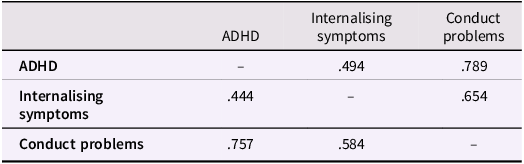
Note. Parameters for the female group above the diagonal and for the males below the diagonal. All correlations were significant at p < .001.
The effects of the emotion dysregulation intercept and slope factors on each outcome were estimated in several different ways to provide sensitivity analyses (Tables 2, S3, and S4). All models suggested that higher initial levels and more positive slopes of emotion dysregulation were associated with all of ADHD symptoms, conduct problems, and internalizing symptoms at age 7. Using partial and full invariance measurement models for emotion dysregulation and latent mental health/neurodevelopmental outcomes, results were highly similar to each other; however, Heywood cases arose in this model (e.g., negative residual variance for conduct problems), therefore, we also fit a version of the model using observed composite scores (which implicitly assumes invariance up to the highest level) and use this version as the primary basis for interpretation (Table 2). Results were again highly similar.
Emotion dysregulation intercept and slope effects on mental health and neurodevelopmental outcomes at age 7 using observed scores for all constructs
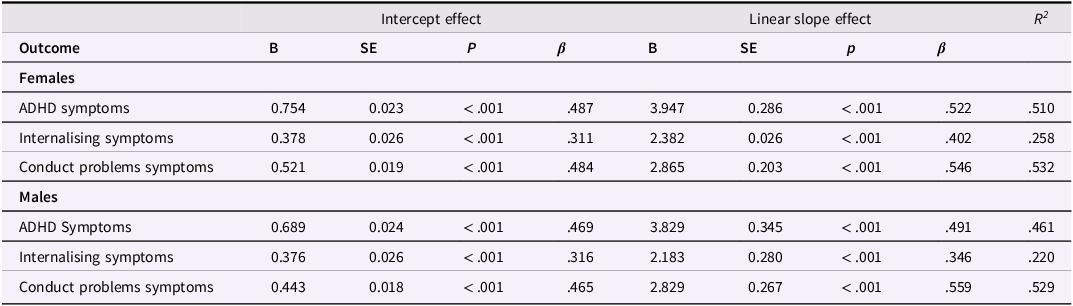
Note. SE = standard error. This model uses observed composite scores for both emotion dysregulation and the mental health/neurodevelopmental outcomes. It includes no adjustment for baseline mental health and neurodevelopmental symptoms. Full model is available at: https://osf.io/res9u.
To estimate the associations between emotion dysregulation trajectories and mental health at age 7 net of baseline levels of mental health, we fit a model adjusted for age 3 ADHD symptoms, internalizing problems, and conduct problems. We additionally fit a model with baseline symptoms as the only predictors of age 7 outcomes to evaluate the extent to which emotion dysregulation trajectories add to their prediction. Given estimation issues, we fit these models only using observed composite scores for all constructs. These showed that initial levels and slopes of emotion dysregulation remained significantly associated with age 7 ADHD symptoms, internalizing symptoms, and conduct problems in both males and females (Table 3). Further, as compared to a model that included only age 3 symptoms as predictors of age 7 symptoms, including the emotion dysregulation intercept and slope boosted the prediction of age 7 outcomes (Table 3).
Emotion dysregulation intercept and slope effects on mental health and neurodevelopmental outcomes at age 7 using observed scores for all constructs adjusted for baseline symptoms
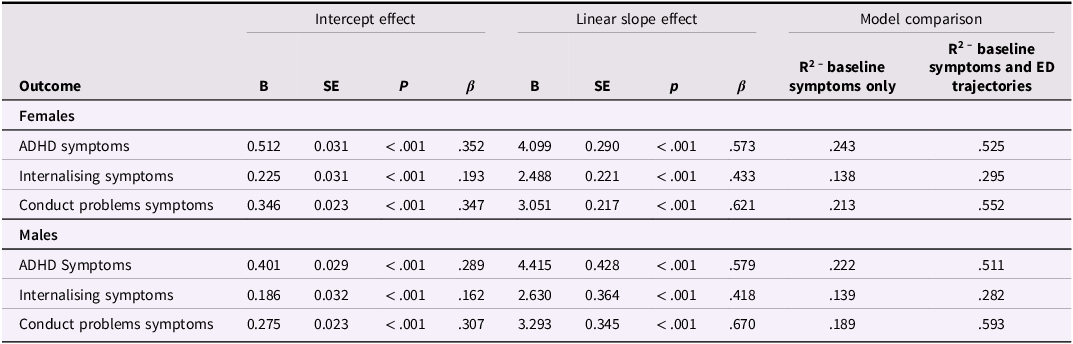
Note. SE = standard error. This model uses observed composite scores for both emotion dysregulation and the mental health/neurodevelopmental outcomes. It includes no adjustment for baseline mental health and neurodevelopmental symptoms. ED = emotion dysregulation. Full model is available at: https://osf.io/cu5rb.
Discussion
In this study, we examined whether developmental trajectories of emotion (dys-)regulation from age 3 to 7 were related to neurodevelopmental and mental health symptoms at age 7. We found that initially higher levels of emotional dysregulation and shallower declines in emotional dysregulation were associated with ADHD symptoms, internalizing problems symptoms, and conduct problem symptoms at age 7. This was true in both male and female children and after adjusting for baseline levels of ADHD symptoms, internalizing symptoms, and conduct problems at age 3. These findings suggest that both levels and rates of growth in emotion regulation are relevant transdiagnostic markers for childhood neurodevelopmental/mental health issues. Repeated measurement of emotion regulation over development may help identify children at risk. Further, supporting emotion regulation development may be an important transdiagnostic target for preventive interventions.
The overall declining trajectory of emotion dysregulation between ages 3 and 7 in both boys and girls in the current sample is consistent with previous research suggesting that this is a period during which children (on average) show a strengthening of their emotion regulation skills (Blandon et al., Reference Blandon, Calkins, Keane and O’Brien2008; Steinberg & Drabick, Reference Steinberg and Drabick2015). Further, the association between emotion dysregulation and ADHD symptoms, internalizing symptoms, and conduct problems adds to previous evidence that suggests that emotion (dys-)regulation is a transdiagnostic factor in child mental health (Antony et al., Reference Antony, Pihlajamäki, Speyer and Murray2022; Steinberg & Drabick, Reference Steinberg and Drabick2015).
Though some studies have examined related functional outcomes such as resilience (Noroña-Zhou & Tung, Reference Noroña-Zhou and Tung2021), our study is among the first to examine the links between early developmental trajectories of emotion (dys-)regulation and school-age mental health. These findings suggest that slower declines in emotion dysregulation are a transdiagnostic marker for mental health issues. This was the case for both males and females, when adjusting for baseline mental health, and when adjusting for either baseline levels of emotion dysregulation or attained levels of emotion dysregulation. As such our findings suggest that failing to meet expected rates of reduction in emotion dysregulation provides unique information about risk for mental health issues by school entry.
Our findings invite further research into the potential benefits of interventions in the preschool years to support better emotion regulation developmental trajectories for the prevention of mental health and neurodevelopmental issues. However, even if a causal role of emotion regulation trajectories is not confirmed, our findings suggest that they could serve as a marker for issues around the age of school entry. As such, monitoring of emotion regulation developmental trajectories could help identify which children may benefit from enhanced preventive support before mental health issues emerge.
Future directions
Building on the current findings future studies could examine the relations between the developmental trajectories of specific aspects of emotion regulation and mental health issues. Emotion regulation and dysregulation are broad terms that can encompass many aspects, including issues such as emotion lability, reactivity, inertia, as well as emotion regulation strategy use (e.g., suppression or cognitive re-appraisal) and interpersonal emotion regulation (Faraone et al., Reference Faraone, Rostain, Blader, Busch, Childress, Connor and Newcorn2019; Speyer et al., Reference Speyer, Brown, Ribeaud, Eisner and Murray2022; Williams et al., Reference Williams, Morelli, Ong and Zaki2018) and some aspects may be more important than others. For example, it has been suggested that negative emotional lability may be more important for co-occurring aggression with ADHD than positive emotional lability (Slaughter et al., Reference Slaughter, Leaberry, Fogleman and Rosen2020). Further, future studies could extend investigations beyond the preschool to early school years and examine longer term trajectories of emotion (dys-)regulation. Emotion regulation trajectories over the transition to adolescence may be particularly valuable to examine as this is an established critical period with respect to mental health and behavioural issues, in which changes in emotion and emotion regulation are assumed to be central (Barbot & Hunter, Reference Barbot, Hunter and Grigorenko2012; Rapee et al., Reference Rapee, Oar, Johnco, Forbes, Fardouly, Magson and Richardson2019). A further future direction concerns potential mechanisms, for example, emotion regulation has been proposed to impact mental health partly via mediators such as peer problems (Murray et al., Reference Murray, Speyer, Thye, Stewart, Obsuth, Kane, Whyte, Devaney, Rohde and Ushakova2023). As such, future studies could examine concurrent trajectories of emotion dysregulation and peer problems and their potential joint roles in the risk of mental health issues in childhood. Finally, future studies could more directly examine (and statistically test) potential gender differences in emotion dysregulation trajectories and their links to mental health outcomes.
Limitations
It is important to acknowledge the limitations of the current study. First, the measure of the emotion dysregulation was brief and did not capture all components of emotion regulation and dysregulation that have been discussed in the literature. Replication with more comprehensive measures could help to disentangle which aspects of emotion (dys-)regulation are most critical as markers of childhood mental health. The measures of mental health were similarly brief and thus subject to analogous limitations. For example, the emotional problems subscale of the SDQ does not provide separate anxiety versus depression scores and the ADHD subscale does not provide separate inattention and hyperactivity/impulsivity scores. Second, both emotion dysregulation and mental health were measured using parent informant reports only. A multi-informant perspective on child development is considered the gold standard since different informants can provide insights into symptoms and behaviors in different contexts and in interaction with different adults (De Los Reyes, Reference De Los Reyes2011) and different informant reports can produce different estimates of developmental trajectories (Murray et al., Reference Murray, Booth, Ribeaud and Eisner2018). The use of the same informant for estimating the emotion dysregulation trajectories and mental health outcomes (usually the child’s mother) also means that these associations could be inflated by common rater bias (Podsakoff et al., Reference Podsakoff, MacKenzie, Lee and Podsakoff2003). Future studies taking a multi-informant approach complemented by observer measures could help provide a more complete picture of how emotion dysregulation regulation trajectories in childhood relate to mental health outcomes. Additionally, as there were only three timepoints of developmental available we could not provide a highly detailed picture of trajectories nor explore higher-order growth. Finally, our observational design does not support causal claims regarding the role of emotion dysregulation in mental health and it is thus not clear whether emotion dysregulation issues cause or are merely a marker for mental health issues. This could be explored in future research using intervention designs.
Conclusions
Over and above concurrent levels of emotion dysregulation, slower declines between age 3 and 7 predicts ADHD symptoms, internalizing symptoms, and conduct problems at age 7. This suggests slower acquisition of emotion regulation skills in the preschool years could be a marker for mental health issues by school age. Future research could explore the effect of interventions to support emotion regulation skill acquisition on children with slower-developing abilities on mental health risk around school entry.
Supplementary material
The supplementary material for this article can be found at https://doi.org/10.1017/S0954579424001263.
Acknowledgments
The authors would like to thank the Millennium Cohort Study team for collecting the data necessary and authorising this study; at the same time also thanking the cohort members and their families across the United Kingdom.
Funding statement
None.
Competing interests
None.


 Open access

